
Search Douglas County Court Records
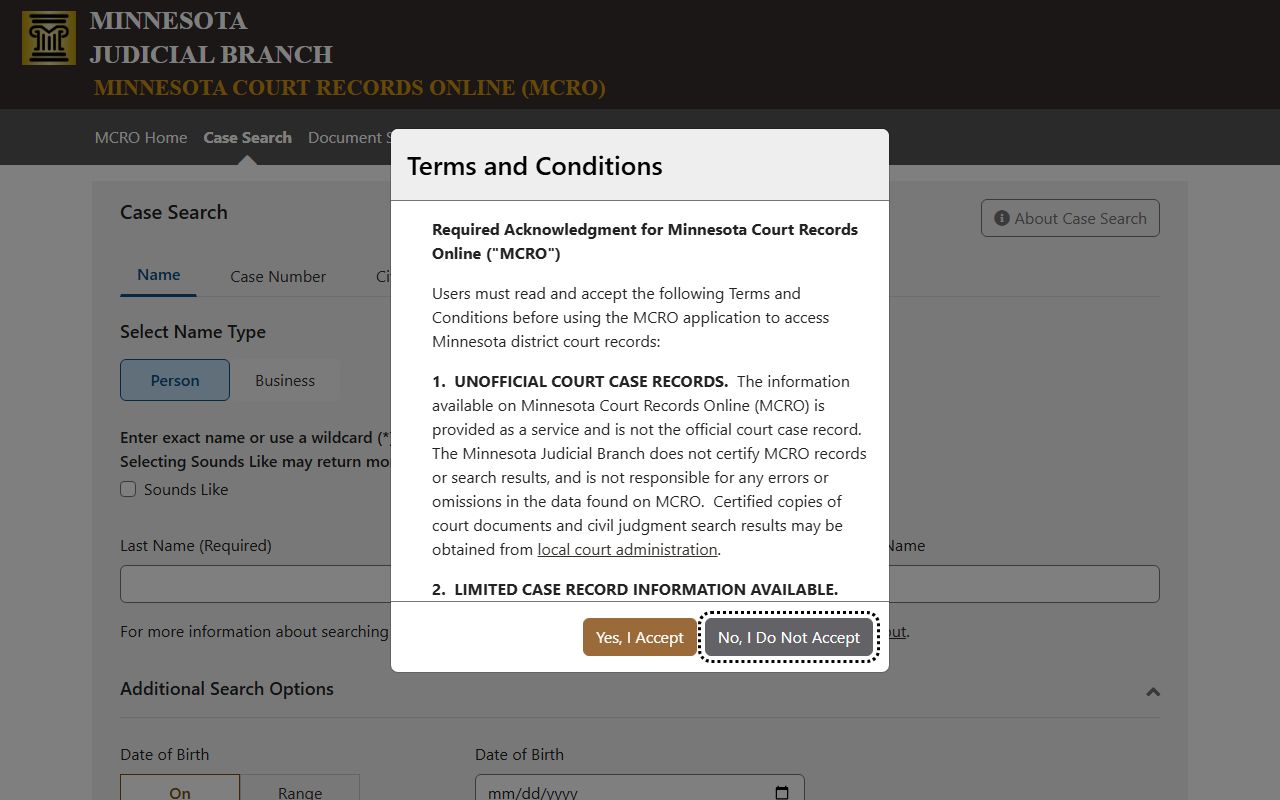
Douglas County court records are searched through Minnesota Court Records Online, usually called MCRO. The system covers Minnesota District Court records, so it is the primary online access point for Douglas County civil, criminal, family, probate, judgment, and traffic case information. Case Search can be filtered to Douglas County, which is important because statewide name searches can return people, businesses, or attorneys from other counties.
The search should match the question. Use a party name when the case number is not known. Use a case number when it appears on a notice, citation, daily calendar entry, or warrant record. Use Hearing Search for scheduled court dates, Document Search for public filings by case number, and Judgment Search for docketed money judgments. If MCRO does not show the record, the next access point is the courthouse public terminal or Douglas County Court Administration.
- Open MCRO Case Search and choose the search tab that matches the known information.
- Enter the person name, business name, case number, citation number, attorney name, or attorney bar number.
- Use the court-location filter to select Douglas County before running a broad name search.
- Open the case detail or register of actions and compare parties, filing date, case type, hearings, and status.
- Use Court Administration for certified copies, older paper files, or records that need courthouse terminal review.
The Minnesota Judicial Branch Douglas County District Court page confirms the local court and points searchers back to state court access tools.
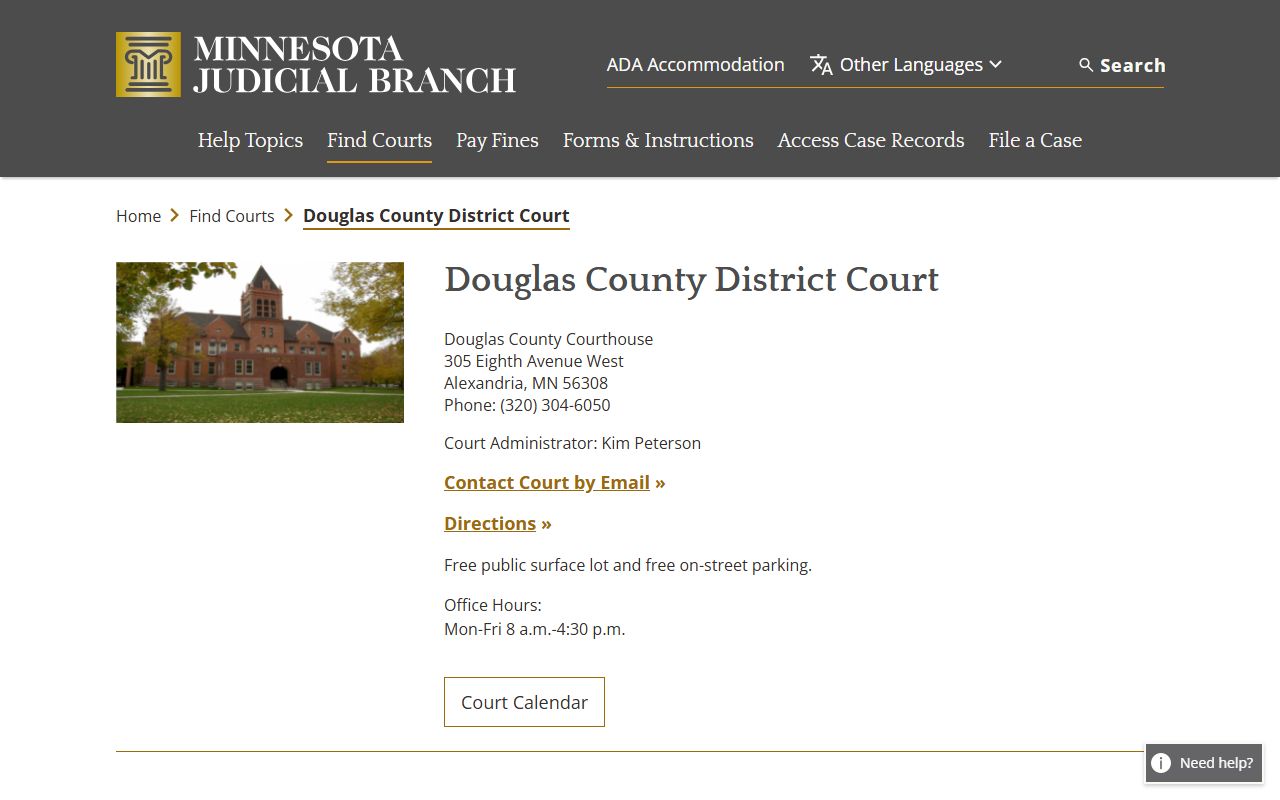
That court page is the local anchor for Douglas County Court records because it identifies the Alexandria courthouse, the district court role, and official links for calendars, fees, and court administration.
Douglas County Case Search Fields
MCRO gives several search paths for Douglas County Court records. A broad person-name search can work, but the county filter, date filed filter, and case category options help remove unrelated statewide results. A citation search is useful for traffic matters, while attorney and bar-number searches help when the lawyer is the known fact instead of the party name.
| Field Label | Type | Required | Format Notes |
|---|---|---|---|
| Search tabs | Tab or radio | Conditional | Person, business, attorney, case number, citation number, or attorney bar number. |
| First, middle, last name | Text | Conditional | Used for person searches; date of birth filters can refine common names. |
| Case Number | Text | Conditional | Examples include 21-CR, 21-CV, 21-FA, 21-PR, and 21-VB formats. |
| Date Filed | Date filter | Optional | Search by exact date or date range when filing timing is known. |
| Case Category | Checkbox | Optional | Civil, Criminal, Family, Probate or Mental Health. |
| Court Locations | Selector | Optional | Select Douglas County to narrow statewide court locations. |
The Douglas County Court Administration page describes the local office that processes these court matters.
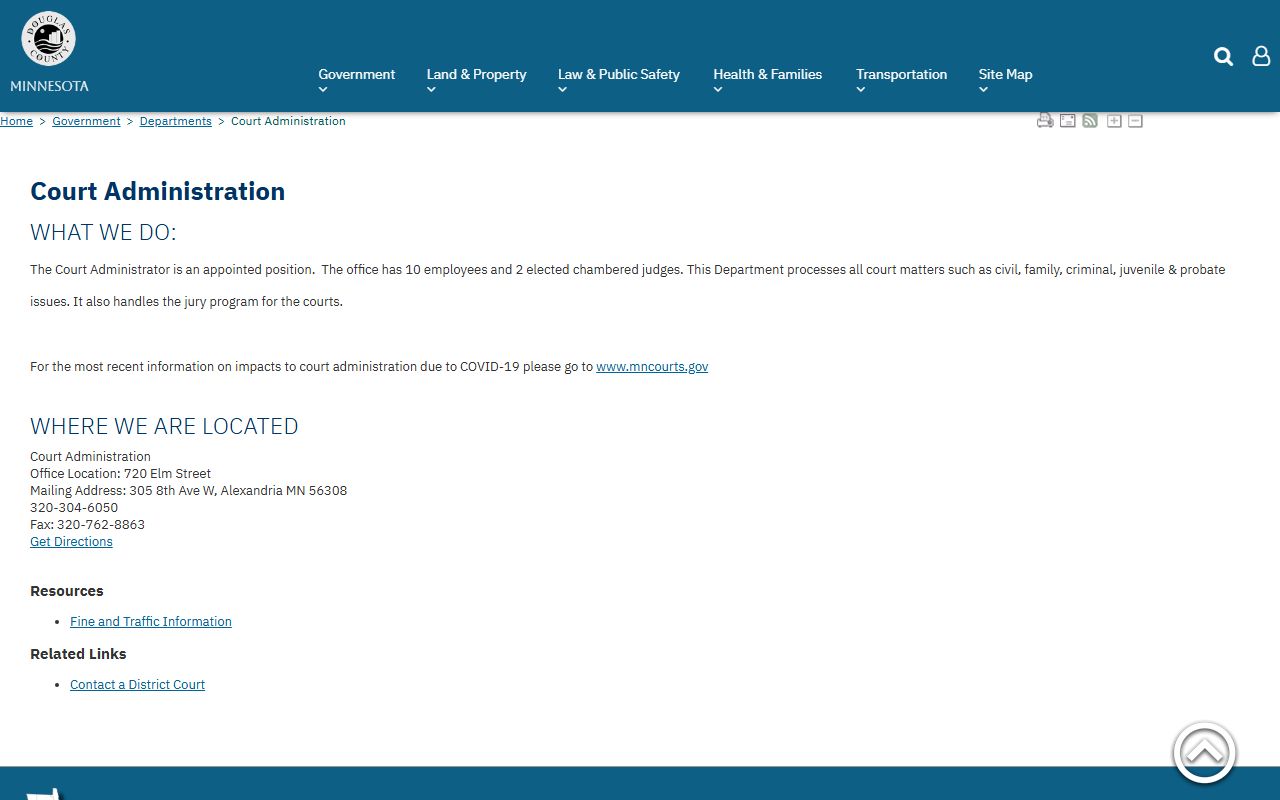
Court Administration is the fallback when online search fields cannot answer a certified-copy, older-file, or terminal-access question.
Douglas County Court Structure
Minnesota uses a unified trial court structure for ordinary state cases. Douglas County does not have separate JP courts, county courts at law, or municipal courts for the record types covered here. Civil, family, probate, juvenile, criminal, traffic, conciliation, harassment, implied-consent, and many protective-order matters route through Douglas County District Court. That is why MCRO is the main case search, not a county-only portal.
Douglas County is part of the Seventh Judicial District, along with Becker, Benton, Clay, Mille Lacs, Morrison, Otter Tail, Stearns, Todd, and Wadena counties. Appeals from Douglas County District Court generally move to the Minnesota Court of Appeals, with further review by the Minnesota Supreme Court only in selected matters. Court Administration at the courthouse handles the local case-processing side of this structure.
The Seventh Judicial District overview places Douglas County inside a multi-county court administration system.
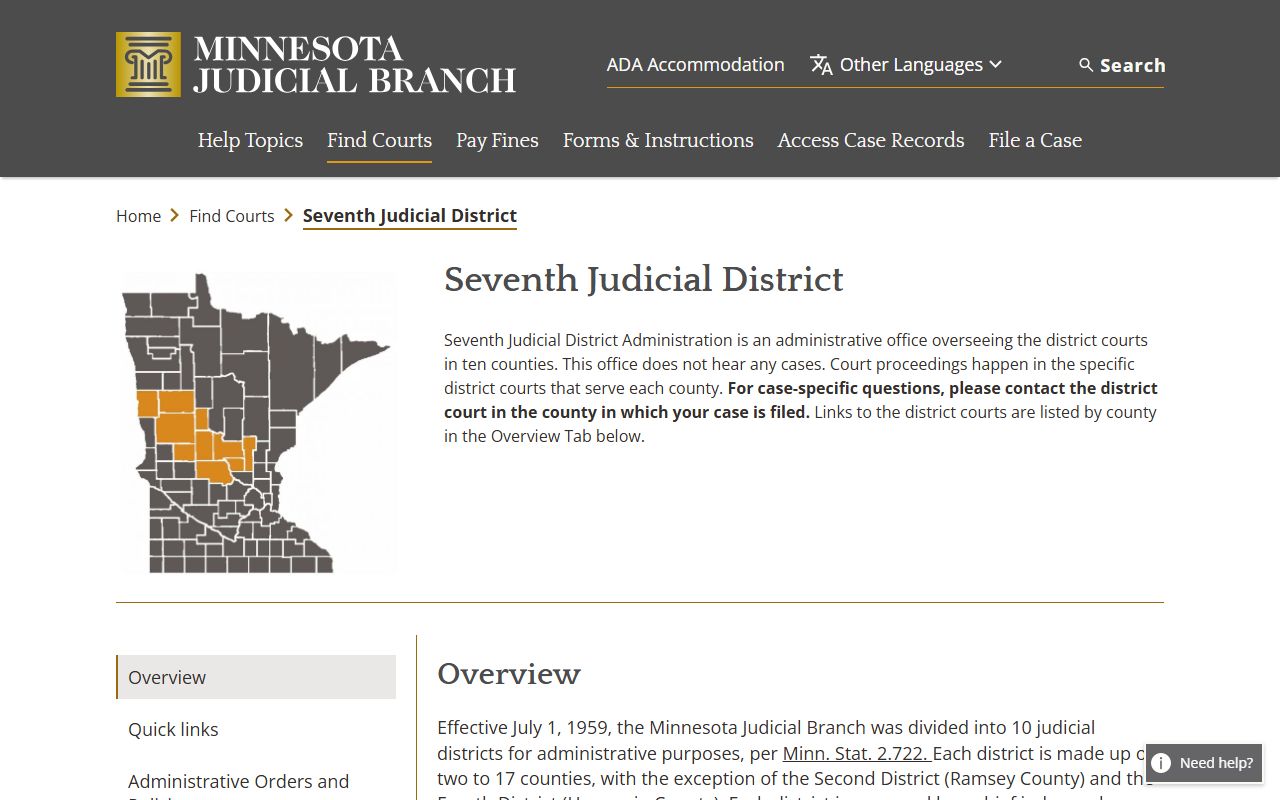
This matters for record searches because district-wide administration does not change the local filing venue: Douglas County cases remain Douglas County District Court files.
Case flow: Douglas County District Court › Minnesota Court of Appeals › Minnesota Supreme Court.
| Level | Court or Office | Douglas County Role |
|---|---|---|
| Trial court | Douglas County District Court | Original jurisdiction for civil, family, probate, juvenile, criminal, and traffic cases. |
| Judicial district | Seventh Judicial District | Regional administration for Douglas County and nearby Minnesota counties. |
| Intermediate appeal | Minnesota Court of Appeals | Reviews most final District Court decisions before discretionary Supreme Court review. |
| Highest state court | Minnesota Supreme Court | Reviews selected appeals and oversees statewide court procedure. |
Douglas County Courthouse Offices
The Douglas County Courthouse in Alexandria is the local building for District Court and Court Administration. Court Administration processes civil, family, criminal, juvenile, and probate matters and handles the jury program. The courthouse also houses the Law Library, which is across from Court Administration and has public legal research materials, local ordinances, Minnesota Statutes, selected legal forms, and a public Westlaw computer.
The sheriff, jail, and recorder channels are nearby but separate. Hearings, court copies, and District Court case questions go to the courthouse. Jail custody, bond, visiting, and inmate questions go to the jail. Sheriff incident reports, background checks, and warrant questions go through the Sheriff's Office. Marriage certificates and real estate records go through the Douglas County Recorder.
Douglas County Sheriff's Office
216 7th Avenue W
Alexandria, MN 56308
320-762-8151
Douglas County Court Record Types
Douglas County Court records include several case categories, and each has different access limits. Civil files can include debt, contract, tort, eviction, harassment, implied-consent, judgment, name-change, and conciliation matters. Criminal files include complaints, warrants, first appearances, omnibus hearings, pleas, trials, sentencings, probation violations, and dispositions. Family files include divorce, custody, child support, paternity, orders for protection, and post-decree motions.
Probate files cover estates, wills, trusts, guardianships, and conservatorships. Traffic files often appear as violations bureau or criminal traffic cases, and DWI-related matters may have both criminal and implied-consent civil records. Juvenile and mental-health commitment records exist in District Court, but public access is much more limited. The Minnesota court structure page explains why these categories sit in District Court rather than a separate local court.
The state structure is useful for Douglas County searches because one trial court can produce many different record types.
- Criminal records track filed charges, hearings, pleas, verdicts, disposition, and sentencing.
- Civil records track lawsuits, judgments, motions, orders, and satisfactions.
- Family records include divorce, custody, parenting time, paternity, support, and protection cases.
- Probate records cover estates, trusts, guardianship, conservatorship, and will-related filings.
- Traffic records cover citations, payable cases, court trials, DWI charges, and related court events.
What Douglas County Court Records Show
A Douglas County court record usually begins with a case number. Observed Douglas County calendar examples use prefixes such as CR for criminal, CV for civil, FA for family, PR for probate, and VB for traffic or violations bureau matters. Case details may also show parties, connection type, filing date, case category, status, hearing history, register of actions, public documents, financial obligations, judgment details, or sentencing information.
| Field | What It Shows |
|---|---|
| Case Number | Local MNCIS-style file number, such as CR, CV, FA, PR, or VB examples seen on the Douglas calendar. |
| Parties | Names and roles such as defendant, plaintiff, petitioner, respondent, attorney, or person subject to guardianship. |
| Hearings | Date, time, location, judicial officer, hearing type, connection type, and calendar status. |
| Register of Actions | Chronological event list showing filings, notices, hearings, orders, dispositions, and public documents. |
| Disposition | Final or current result of a charge, claim, motion, citation, probate event, or judgment. |
| Restrictions | Sealed, confidential, juvenile, family, victim, financial, and minor data may be hidden or redacted. |
Douglas County Court Public Access
Minnesota public access rules come from both data-practices statutes and Judicial Branch court-record rules. Minnesota Statutes section 13.03 sets the general rule that government data are public unless a law makes them not public. Court records are also governed by the Minnesota Rules of Public Access to Records of the Judicial Branch, which distinguish public courthouse access from remote online access.
That distinction is practical. MCRO is a strong starting point, but courthouse public terminals provide the most complete electronic District Court access. Paper files, older files, certified copies, and some restricted categories still require Court Administration review. Sheriff records use a different framework under Minnesota Statutes section 13.82, so an arrest report and a criminal case record are not the same file.
Key Minnesota rules:
Minn. Stat. § 13.03 treats government data as public unless another law restricts access.
Minn. Stat. § 13.82 controls release of sheriff and police law-enforcement data.
Minn. Stat. ch. 609A controls criminal expungement and sealing remedies.
Restricted Douglas County Court Records
Not all Douglas County court records are public in full. Juvenile delinquency records are governed by Minnesota Statutes section 260B.171 and are more limited than adult criminal records. Adoption records, mental-health commitments, some family documents, victim data, Social Security numbers, financial account numbers, minor information, and sealed records may be hidden, redacted, or available only to parties, attorneys, agencies, or people with court authority.
Expungement is a common reason a criminal record disappears from public search results. Minnesota expungement is handled under chapter 609A, and section 609A.03 addresses petition-based relief and filing-fee rules. The Douglas County Attorney page states that the County Attorney cannot help private citizens expunge criminal records, so self-represented users normally look to Judicial Branch forms, the Law Library, or private counsel.
Douglas County Specialty Dockets
Minnesota recognizes treatment court models such as adult drug courts, DWI courts, family dependency treatment courts, juvenile drug courts, mental health courts, and veterans courts. The official Douglas County sources reviewed for this build did not identify a separate Douglas County treatment court docket by name, so the record pages should not imply that one exists locally.
Douglas County still has related case activity. The daily calendar includes DWI, probation violation, implied-consent, pretrial, settlement, and hearing events. The County Attorney handles certain civil commitments when immediate safety criteria and qualified health-practitioner support exist. Specialty-court availability should be confirmed with Court Administration or Seventh Judicial District Administration before relying on a program name.
Douglas County Sheriff and Jail
The Douglas County Sheriff is Troy Wolbersen. The Sheriff's Office administration address is 216 Seventh Ave. W in Alexandria, and the jail is at 509 3rd Avenue W. The sheriff's web channels cover the active warrant list, records requests, accident and incident reports, background checks, jail administration, mail rules, visiting information, bond, programs, work release, and the inmate roster. The office also has the Douglas County Sheriff mobile app on App Store and Google Play for tips, crime reporting, public-safety information, and interactive features.
The Douglas County inmate roster is separate from MCRO. It showed a current jail roster with name and keyword search in the research capture, while MCRO shows court cases. The active warrant list is also a sheriff channel. It warns that warrants are served regularly and a listed warrant may already have been served.
Douglas County Marriage Divorce Probate
Marriage certificates are recorder records, not District Court case records. The Douglas County Recorder is custodian of marriage certificates and real estate recordings, while Court Administration handles divorce and probate case files. A statewide marriage search through MOMS can identify the county that issued a license, but certified Douglas County marriage copies come from the Recorder when Douglas County issued the license.
Divorce is a District Court family case. Probate is also handled by District Court as the Probate Division of District Court, not by a separate elected probate court. MCRO can show public family and probate case details, but online documents are limited in family cases and restricted in guardianship, conservatorship, medical, financial, minor, or confidential matters. The dedicated marriage and divorce records and probate records pages separate those channels.
- Testator
- A person who made a will.
- Personal representative
- The person appointed to handle an estate in probate.
- Conservator
- A court-appointed person who manages finances or property for a protected person.
Douglas County Court Records Fees
Douglas County District Court copy and filing fees follow the Minnesota Judicial Branch District Court fee schedule. A record search may be free online, but certified copies, reports, scanning, probate filings, dissolution filings, expungement petitions, and certain judgment actions can have set charges. Sheriff and recorder records use separate fee schedules.
The Minnesota District Court Fees page is the source for many Douglas County Court records fees.
Online search access is only one part of the process; copy and certification rules still control documents needed for official use.
| Item | Amount |
|---|---|
| Uncertified copy of civil or criminal instrument | $0 |
| Certified copy of civil or criminal instrument | $14 |
| Exemplified and certified copy | $28 |
| Case-management report, 1 to 50 pages | $5 |
| Probate first paper for estates, trusts, guardianships, conservatorships | $310 |
| Certified marriage certificate from Recorder | $9 |
Read Douglas County Court Records
Case prefixes help identify the record before reading the full docket. CR marks criminal records, CV marks civil records, FA marks family records, PR marks probate records, and VB marks traffic or violations bureau records observed on the local calendar. A register of actions is the event list. A disposition is the current or final result. A conviction is a court finding or guilty plea, while a charge is only an allegation unless and until the court resolves it.
The daily calendar uses role labels such as defendant, attorney, petitioner, respondent, plaintiff, and person subject to guardianship. Hearing types can include first appearance, bail hearing, omnibus hearing, plea hearing, sentencing, probation violation, order for protection hearing, probate hearing, administrative conference, and court trial. The Minnesota access case records page explains the difference between online access and courthouse terminal access.
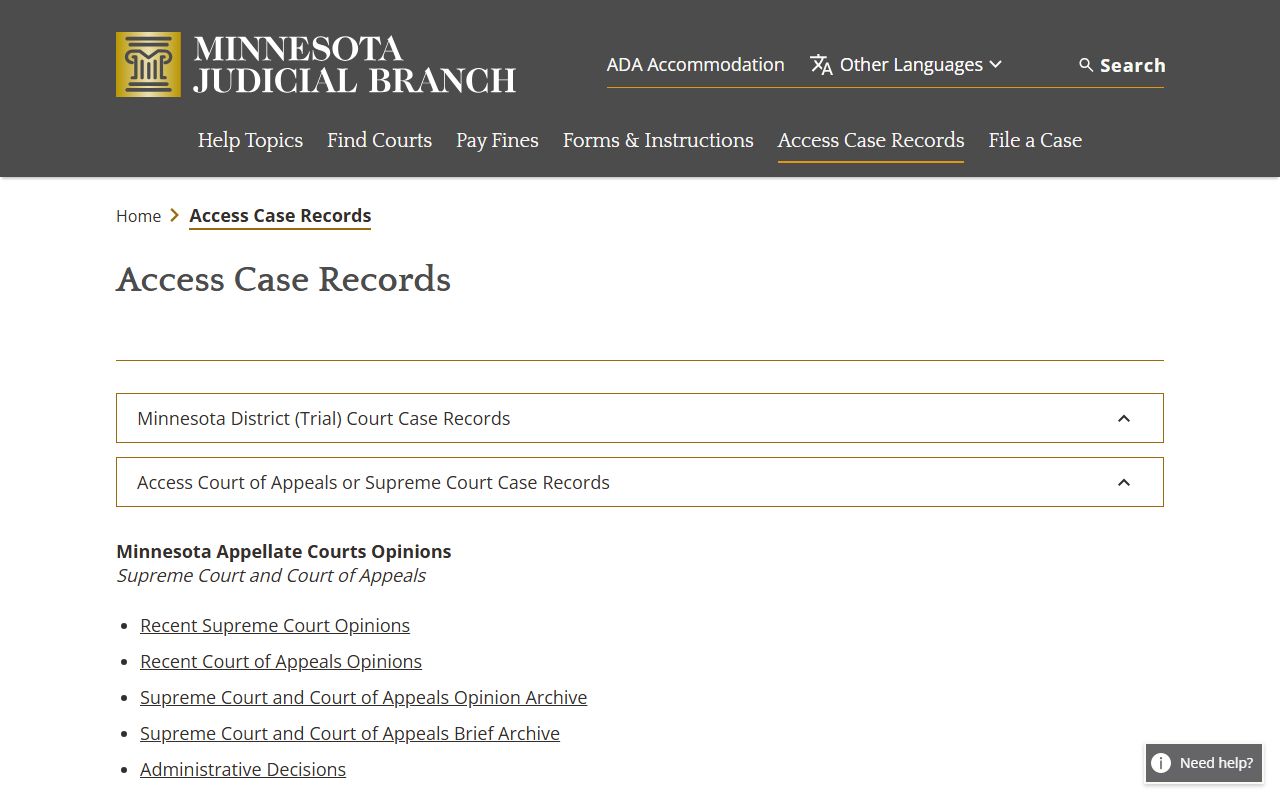
That statewide access page is the practical bridge between a Douglas County online result and a local courthouse request.
Douglas County Record Limits
Online records can lag behind court or sheriff action. The warrant list is dated and warns that a warrant may already have been served. The inmate roster reflects current jail status but does not show the full criminal case file. MCRO does not show all sealed, confidential, juvenile, family, or restricted documents. A citation payment search may work by citation number, while a court record search may require a case number or party name.
Use the custodian that controls the record. Court Administration handles case-file questions, courthouse terminals, certified court copies, and older local court files. The Sheriff's Records Division handles incident reports, booking-related public records, local background checks, and certain law-enforcement data requests. The Recorder handles marriage certificates and land records. The Minnesota DOC and BCA tools are statewide channels, but they do not replace Douglas County court or jail records.
Note: Confirm case status, custody status, warrants, and certified-copy needs with the office that created the record.
Douglas County Court History
Douglas County was created by the territorial legislature in 1858 and organized in 1866. Alexandria is the county seat. Minnesota Judicial Branch courthouse history materials include an image of the Douglas County Courthouse in 1876, which shows the county's long court presence in Alexandria. The modern record system, though, is statewide: Minnesota divided the state into 10 judicial districts for administration effective July 1, 1959, and Douglas County is now in the Seventh Judicial District.
The Court of Appeals began on November 1, 1983, creating a regular intermediate appellate route for trial-court decisions. MCRO modernization is newer: Document Search launched in March 2021, Case Search in December 2021, and Hearing Search and Judgment Search in August 2022. These changes explain why current Douglas County Court records are best searched through state tools first, then verified locally when needed.
The Minnesota Court of Appeals page describes the appellate court that reviews many District Court decisions.
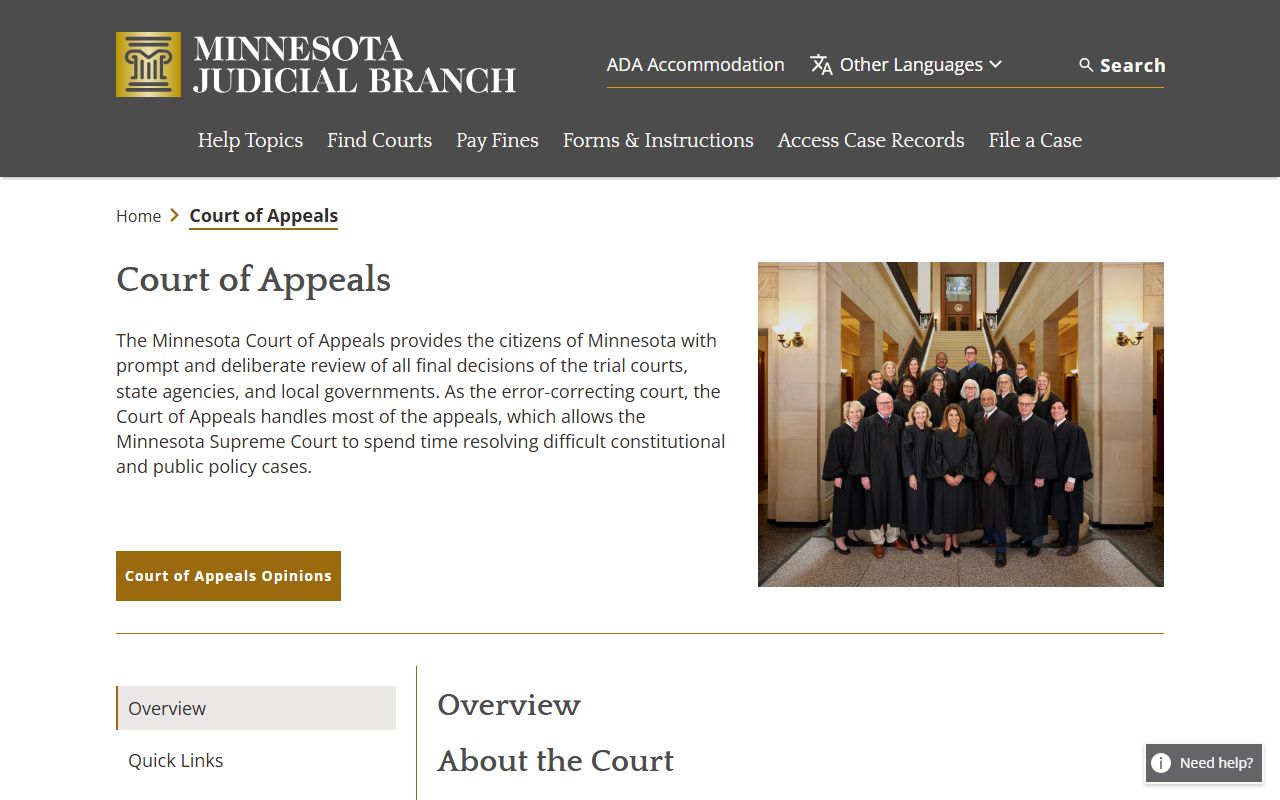
Appeal records are a different layer from Douglas County trial records, but the appeal path starts with what happened in District Court.
Frequently Asked Questions
Where do Douglas County Court records start?
Start with MCRO and filter to Douglas County. Use Case Search for case details, Document Search for public documents by case number, Hearing Search for court dates, and Judgment Search for debtor-name judgment records. If the result is incomplete, use a courthouse public terminal or ask Court Administration.
Is an arrest record the same as a criminal court record?
No. A sheriff arrest or booking record is a law-enforcement record. A criminal court record starts when a complaint, citation, or other charging document is filed in District Court. The jail roster can show current booking charges, but MCRO and Court Administration hold the court case file.
Who handles Douglas County marriage certificates?
The Douglas County Recorder handles marriage certificates when Douglas County issued the marriage license. The Recorder is separate from Court Administration. Divorce records, by contrast, are District Court family records and are searched through MCRO or requested from Court Administration.
Does Douglas County have a separate probate court?
No separate elected probate court was identified. Probate, trust, guardianship, conservatorship, and estate matters are District Court case types handled through Court Administration and MCRO, with access limits for sensitive or restricted details.
Can online records be used as certified copies?
Usually no. Online records are useful for lookup and review, but certified copies must come from the official custodian. Court-certified copies come from Court Administration under the state fee schedule, while certified marriage certificates come from the Recorder.